Academics
ENABLING REAL-WORLD SUCCESS
Academics
The key question to ask of any curriculum is what it seeks to achieve. We know what our curriculum is for: to allow personal ownership, unlock diversity of talent and achieve the greatest understanding of personal strengths and weaknesses, on which all real-world success is based.
We want all our students to feel investment, recognition, and a clear sense of their own individual progress, that will lead them to diverse choices from among the world’s best outcomes, from universities and colleges to degree apprenticeships and entrepreneurship.
Four Dimensions of Learning
Our curriculum has four underlying strands:
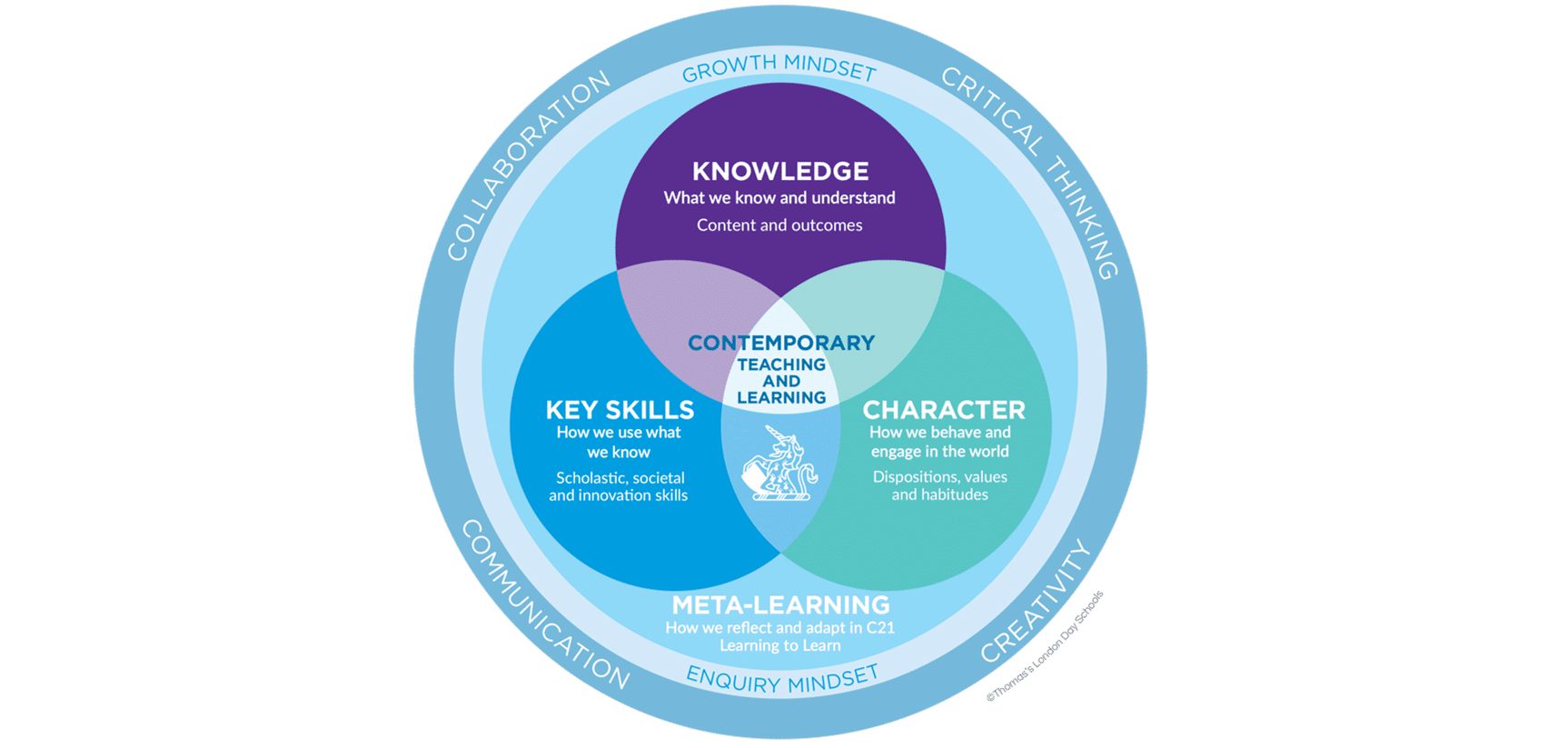
Together, these develop an enquiry and growth mindset, with students excited by challenge, and unafraid to fail in order to unlock success. They think, question, collaborate and lead. They develop the habits of mind that underpin effectiveness of action and commitment.
Stretch and Challenge for All
We passionately believe in a diversity of excellence and creativity. We know the world’s best workplaces nurture different forms of intelligence. We all know adults who thrive in the real world, having been made to feel like failures at school.
Our commitment is to the same diversity of excellence and intelligence as the best workplaces. We are committed to a holistic selection process that focuses on personality, potential and imagination, not hoop-jumping and ineffective cognitive assessment.
And we nurture creativity and freedom of thought in students once they arrive. This means that traditionally excellent academic students seeking the most competitive outcomes learn alongside other outstanding creative minds. Students learn from and with each other – which makes them ready for a real world where they will meet brilliant people from a wide range of backgrounds.
Blue-chip and Globally Recognised Qualifications Alongside a Brand-new Alternative
This is our flagship educational reform and the heart of what makes Thomas’s College different.
All our students explore a wide range of academic disciplines with a sense of freedom and adventure from Lower Fourth (Year 7) to Upper Fifth (Year 10). They refine their choices as they go, and from around the Lower Fifth onwards (Year 9), they are being taught the skills and content they will need for GCSE examinations. But those examinations do not yet dominate their learning.
At the start of Lower Sixth (Year 11), they choose which of their subjects they will take to GCSE examinations at the end of the year, and which they will take to Thomas’s Qualifications (TQs) – our own new and innovative assessments encouraging real-world skills and abilities.
Many schools are offering educational reform, and the majority of top London schools are exploring alternatives to GCSE. We are the only school, however, providing this reform on your terms, and putting families in charge of the balance between the new and the traditional.
Many of our young people will take GCSEs in the majority of their courses, with a small number of TQs giving them the chance to develop the skills they need in a changing world. Some may take more TQs to prepare them for entrepreneurial and creative pathways. Taking TQs is not about closing doors to traditional outcomes. It is about giving young people the confidence and abilities to stride through those doors, ready to make an impact on the world.
The same approach applies in Middle and Upper Sixth (Years 12-13). Students choose major and minor courses, an approach inspired by United States universities. Most will take 3 or 4 majors to A Level, and also explore a project qualification. But uniquely, they also have access to minor subjects leading to TQs and other outcomes.
Thomas’s Qualifications (TQs)
TQs have already been recognised by UCAS, the UK university admissions system. We’re confident that the right mix of TQs will enhance the academic profile of every student in our school.
TQs are a revolutionary form of assessment. They are very different from traditional exams: they have been designed and developed to meet the emerging needs of academically able, socially aware and globally minded students.
Most students will gain the majority of the qualifications via tried and tested GCSEs and A Levels. Where they opt for a TQ, they will gain in addition future-ready learning: exactly the additional skills and evidence of creative thought that the most competitive university and other outcomes require.
TQs offer students the chance to practise while still at school the type of assessment and challenge they will face in tertiary education and the workplace, allowing them to get ahead in the transition from school study to real-world learning.
Each student chooses one of four assessment pathways, with our guidance ensuring a mix of skills are represented overall.
- TQ Connection: linking school-learning to issues in the contemporary world
- TQ Communication: assessment through oracy
- TQ Creativity: making an artefact to explore a topic
- TQ Critical thinking: creating a website or informative exhibit to explain complex subjects
More information about how these assessments work is included in our curriculum guides. Our student journey and Sixth Form pages have lots more information that explain the excitement and innovation of our unique curriculum.
The quality of teaching is truly excellent and our son has been inspired on the academic front.
– Thomas’s College Parent
Learning Enrichment
At Thomas’s College, SEND is known as Learning Enrichment. Thomas’s seeks to encourage a diverse community to which individuals may contribute as fully as possible. It aims to create conditions whereby students are treated solely on the basis of their merits, abilities and potential. We firmly believe that high-quality teaching, differentiated and adapted for individual students, is the first step in responding to students who have or may have SEN. Additional intervention and support cannot compensate for a lack of good quality teaching.
Every teacher is a teacher of SEND and inclusion is a thread that runs through every area of the school, enhanced by collaboration between the Leadership Team, teachers, support staff, external agencies, parents and most importantly, each child. The Learning Enrichment department is located centrally in the College so it is easy for students to drop-in.